PastNoise
Science & Cosmos·6 acts·7m 54s·3/6 primary·4 citations·Cut from 10,000 live hits

Why Earth Never Boils Over: The Hidden Machinery That Keeps a Planet AlivePlate Tectonics Earth System · Primary Podcast Clips & Verified Transcript

Volcanoes double as a thermostat, tsunamis arrive invisible, and stars can wreck us without ever hitting. Six acts on how a world stays livable.

The Ring of Fire Lights Up the Pacific

ACT I · CrashCourse · 7m 54s

The Ring of Fire Lights Up the Pacific

Almost all the planet’s earthquakes and volcanic eruptions happen in one place.

00:00 / 07:54
0%
Highlights:
ACT IPRIMARYCrashCourse · Jun 25, 2026

The Ring of Fire Lights Up the Pacific

CrashCourse says almost all earthquakes and eruptions cluster along the Ring of Fire.

Click any timestamp to jump directly

30-Second Quick Reference · Verified Takeaways

6 acts · 4 citations · Last Verified Nov 21, 2026
  • 01CrashCourse notes that almost all earthquakes and volcanic eruptions occur in one place, the Ring of Fire.
  • 02SciShow Space says plate tectonics helped oxygenate the atmosphere and stabilize climate through volcanic carbon dioxide over billions of years.
  • 03AcademicEnglishHelp frames earthquake risk as a timing question: the reading concludes that an earthquake is only a question of when.
  • 04Sara Seager argues that robust evidence of life on another planet would have incredible scientific consequences, especially if life emerged twice independently.
“Most earthquakes and eruptions cluster along the Ring of Fire, a direct signal of moving plates.”

Core Synthesis

Plate tectonics is a geology lesson with planetary consequences. CrashCourse locates most quakes and eruptions in the Ring of Fire; SciShow links volcanic carbon dioxide to long-term climate stability. The written record places plate motion over 3 to 4 billion years and ties it to Earth system science. Kurzgesagt and Sara Seager widen the frame: planetary stability and independent life depend on conditions we are still learning to read.

01

Hazards Cluster on the Ring

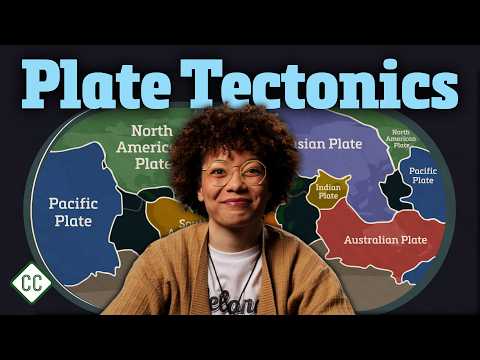
CrashCourse opens with a blunt geographic fact: almost all earthquakes and volcanic eruptions happen in one place, the Ring of Fire. The written record explains why the phrase is not rhetorical. Tectonic plates are pieces of crust and uppermost mantle, roughly 100 kilometers thick, moving slowly for billions of years. PBS Eons interrupts its seahorse episode with a calendar advertisement, a small reminder that public science arrives through sponsored formats.

The Ring of Fire is a map of plate boundaries, not a metaphor.
02

Volcanoes and Climate Stability

SciShow Space shifts from hazards to habitability. On Earth, plate tectonics is believed to have helped oxygenate the atmosphere and keep climate stable over billions of years; volcanic carbon dioxide helps keep the planet warm. AcademicEnglishHelp shows a classroom reading closing on earthquake risk: an earthquake is only a question of when. The Müller reference frames plate tectonics within Earth system science, where rock and atmosphere exchange consequences across deep time.

Climate stability is a geological product, not a background condition.
03

Planetary Neighbors and Life

Kurzgesagt considers a rogue Earth changing neighborhoods constantly. Space is big, and stars are unlikely to hit us, but they do not need to collide to make us vulnerable. Sara Seager argues that robust evidence of life on another planet would have incredible scientific consequences, especially if life emerged twice independently. The literature on plate tectonics and metamorphic thermal regimes asks when Earth first adopted this behavior, a question with implications for any habitable world.

Independent life would turn one planet's geology into a comparative science.

Where Voices Converge

  • • Plate tectonics explains why earthquakes and volcanic eruptions concentrate along boundaries such as the Ring of Fire.
  • • Plate motion is ancient, with the literature placing it over 3 to 4 billion years, and it connects geology to climate and habitability.

Nuance & Unresolved Tension

  • • Popular science segments compress uncertainty into clean claims, while classroom and academic sources stress timing, evidence, and open questions.
  • • Planetary habitability claims depend on Earth analogies, yet Kurzgesagt and Seager show that stellar neighborhood and independent life remain speculative.

Explore Related Questions

Complete Timestamped Bilingual Transcript

Full 6-Act Spoken Transcript Archive

Click any timestamp to jump
ACT I · CrashCourse · 00:00 - 00:55

The Ring of Fire Lights Up the Pacific

ACT II · PBS Eons · 00:00 - 01:35

Carcinization: Evolution Keeps Inventing Crabs

ACT III · AcademicEnglishHelp · 41:27 - 42:19

Tsunamis: The Invisible Threat Nobody Sees

ACT IV · SciShow Space · 00:43 - 02:18

Volcanoes Run Earth's Climate Thermostat

ACT V · Kurzgesagt – In a Nutshell · 00:15 - 01:48

Nearby Stars Can Ruin Earth Without Hitting

ACT VI · Big Think · 00:11 - 01:35

If Life Began Twice, the Galaxy Teems

Want sentence-level movie clips, connected-speech breakdowns, or daily spoken English drills instead of long-form interviews? Our sister tool WinkLingo is purpose-built for that workflow.

Key Questions & Reference Guide

Frequently Asked Questions

What are the core takeaways on Plate Tectonics Earth System?

Plate tectonics is a geology lesson with planetary consequences. CrashCourse locates most quakes and eruptions in the Ring of Fire; SciShow links volcanic carbon dioxide to long-term climate stability. The written record places plate motion over 3 to 4 billion years and ties it to Earth system science. Kurzgesagt and Sara Seager widen the frame: planetary stability and independent life depend on conditions we are still learning to read. Key insights include: CrashCourse notes that almost all earthquakes and volcanic eruptions occur in one place, the Ring of Fire. SciShow Space says plate tectonics helped oxygenate the atmosphere and stabilize climate through volcanic carbon dioxide over billions of years.

Which primary podcasts, lectures, and speakers are featured in this Plate Tectonics Earth System screening?

This screening stitches 6 continuous acts featuring voices from CrashCourse, PBS Eons, AcademicEnglishHelp, SciShow Space, Kurzgesagt – In a Nutshell. Every act separates primary voices from commentary and links directly to the original timestamp.

Where do experts agree and disagree on Plate Tectonics Earth System?

Convergence: Plate tectonics explains why earthquakes and volcanic eruptions concentrate along boundaries such as the Ring of Fire. Open tension: Popular science segments compress uncertainty into clean claims, while classroom and academic sources stress timing, evidence, and open questions.

Does this Plate Tectonics Earth System page include a searchable timestamped transcript and citations?

Yes. Open the Interactive Transcript tab to click any sentence and jump directly to that exact second in the video, export Obsidian/Notion reading notes, and verify 4 cross-referenced scholarly or encyclopedic citations including "List of tectonic plates".

More Documentaries in This Topic

Science & Cosmos →
The Universe Is Speeding Up: How Astronomers Found Dark Energy
Science & Cosmos6m 57s

The Universe Is Speeding Up: How Astronomers Found Dark Energy

Charles Bailyn confirms logarithmic magnitudes while Alex Filippenko's supernova teams turn expansion history into data. Katie Mack links E=mc2 to cosmic energy budgets, Daniel Whiteson explains redshift, and the literature states that dark energy drives accelerating expansion. Two clean-energy acts use the word acceleration for terrestrial transitions, exposing a category drift in the dossier.

6 acts5 primary4 citations
Where Does Information Go When It Falls Into a Black Hole?
Science & Cosmos6m 48s

Where Does Information Go When It Falls Into a Black Hole?

Brian Cox treats the smallest sensible distance as a practical limit, then ties it to information stored on a surface. Avi Loeb names the Schwarzschild radius; Crash Course and Kurzgesagt describe the horizon as a boundary hiding a singularity. PBS Space Time and BBC Earth Science frame the same edge as a contested site of gravity research.

6 acts4 primary2 citations
The Particle Hiding Under a Mine
Science & Cosmos7m 17s

The Particle Hiding Under a Mine

The axion was proposed to solve a subtle inconsistency in fundamental forces, then became a dark matter candidate. Underground labs suppress cosmic noise, but uranium and thorium decay into radon and complicate the search, while ADMX tunes a radio-like cavity and hybrid magnonics and neutron-star research widen the field. The 2019 signal remains interesting, not definitive.

6 acts2 primary4 citations
Leonard Susskind: The Universe Isn't Made of Points
Science & Cosmos5m 46s

Leonard Susskind: The Universe Isn't Made of Points

MIT's lecture frames QFT as an interpretive problem before it is a formalism. Susskind talks about programming a quantum field theory, Ash distinguishes point particles from strings, and Jaimungal points to foundations. The written record names the next step: extend QFT from Minkowski spacetime to curved spacetime, while quantum gravity remains unresolved.

6 acts2 primary4 citations
The 85 Percent Problem: Dark Matter or Broken Gravity?
Science & Cosmos8m 03s

The 85 Percent Problem: Dark Matter or Broken Gravity?

Neil deGrasse Tyson frames the problem as measurement of collective gravity, not a verdict on dark matter. PBS Space Time and Don Lincoln stress that dark matter is inferred only through gravity and that galactic details matter. MOND and dark energy references widen the dispute: either add unseen mass, revise gravity, or confront acceleration on cosmic scales.

6 acts4 primary2 citations
The Big Bang Wasn't the Beginning. Here's What the Evidence Says
Science & Cosmos6m 31s

The Big Bang Wasn't the Beginning. Here's What the Evidence Says

The dossier tracks how cosmic inflation moved from a fix for Big Bang puzzles to a probe of evidence. MIT lecture material, Lawrence Krauss on impossible accelerators, and Ethan Siegel on a pre Big Bang epoch sit beside Arvin Ash's caution that the Big Bang model leaves origins unexplained. The literature confirms inflation as exponential early expansion while leaving cause and testability open.

5 acts3 primary4 citations