PastNoise
Science & Cosmos·6 acts·7m 32s·1/6 primary·4 citations·Cut from 10,000 live hits

The Future Already Exists: Sean Carroll's Case for Block TimeBlock Universe Eternalism Time · Primary Podcast Clips & Verified Transcript

What if every possibility already exists, wormholes hide in plain sight, and a tiny demon can break physics? Six acts trace the strange price of time.

Every Alternate History Happens at Once

ACT I · Big Think · 7m 32s

Every Alternate History Happens at Once

I mean both in the future, science fiction has imagined all sorts of different possibilities.

00:00 / 07:32
0%
Highlights:
ACT IPRIMARYBig Think · Dec 18, 2022

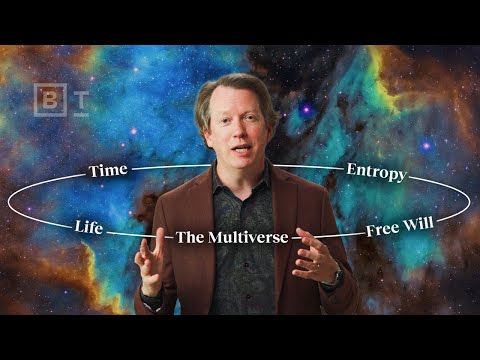
Every Alternate History Happens at Once

Carroll uses speculative storytelling to introduce all times as equally real.

Click any timestamp to jump directly

30-Second Quick Reference · Verified Takeaways

6 acts · 4 citations · Last Verified Nov 21, 2026
  • 01Carroll notes science fiction and alternate history train us to treat all times as equally available to narrative.
  • 02PBS Space Time says quantum symmetries include charge, handedness, and time direction, yet those symmetries break one by one.
  • 03Hawking's program asks whether portals to the past or future could exist within known physics, not merely in fiction.
  • 04Beeyond Ideas recalls that an information and order problem sat open for over 100 years, with everyone sensing something was wrong.
“Eternalism says every moment is real, while presentism says only now exists.”

Core Synthesis

Sean Carroll treats all times as equally real, and PBS Space Time ties that block-universe view to quantum symmetries and reversed time. The philosophy literature keeps presentism and the growing block as live rivals. The CNBC antitrust clip is a search-term false lead, useful only as a reminder that Time Warner can pull unrelated material into a time documentary.

01

Carroll and the Block

Carroll's Big Think segment begins with science fiction and alternate history, then moves toward a physical picture in which all moments have equal standing. Eternalism, as the philosophy reference states, treats all existence in time as equally real. Daniel Peterson's relativity paper defends that block view, while the growing block reference keeps the future open. Carroll's narration supplies the accessible frame; the literature supplies the ontological argument.

Carroll gives the block universe a public narrative entry point.
02

Symmetry and Reversed Time

PBS Space Time describes quantum theory through symmetries: charge, handedness, and time direction should not distinguish our universe from a mirror opposite. The excerpt notes those symmetries break one by one. Beeyond Ideas adds a century-old information and order problem that left physicists convinced something was wrong. Together they show why reversed time and block time are technical puzzles, not mere metaphors, and why the literature on relativity and simultaneity matters.

Quantum symmetry breaking keeps reversed time a live physics question.
03

Portals, Antitrust, and Errors

Hawking's segment asks whether portals to the past or future could exist within physics, a practical version of the eternalist question. The CNBC antitrust discussion is about a corporate merger, not time, and its presence exposes a retrieval mistake. Aperture's Novalis line arrives without context. These acts contrast sharply: one poses a real thought experiment, two illustrate how search results and loose quotation can blur a documentary's evidentiary line.

Search terms can pull unrelated Time Warner material into time research.

Where Voices Converge

  • • Eternalism treats past, present, and future as equally real, matching Carroll's narrative framing.
  • • Relativity of simultaneity gives the block universe serious physical support, as Peterson's paper argues.

Nuance & Unresolved Tension

  • • Presentism and growing block theories keep the future open, so eternalism is not the only philosophically live option.
  • • The file mixes real physics with unrelated merger coverage and a decontextualized Novalis quotation, weakening evidential coherence.

Explore Related Questions

Complete Timestamped Bilingual Transcript

Full 6-Act Spoken Transcript Archive

Click any timestamp to jump
ACT I · Big Think · 04:05 - 05:40

Every Alternate History Happens at Once

ACT II · PBS Space Time · 00:03 - 01:38

Quantum Symmetries Keep Breaking Physics

ACT III · Your Discovery Science · 00:07 - 01:13

Wormholes Everywhere, Too Small to See

ACT IV · CNBC · 00:00 - 00:48

Why Vertical Mergers Worry Antitrust Less

ACT V · Aperture · 19:43 - 20:39

Spinoza's God Is Everywhere, Not Above

ACT VI · Beeyond Ideas · 15:01 - 16:33

Maxwell's Demon Must Observe Every Molecule

Want sentence-level movie clips, connected-speech breakdowns, or daily spoken English drills instead of long-form interviews? Our sister tool WinkLingo is purpose-built for that workflow.

Key Questions & Reference Guide

Frequently Asked Questions

What are the core takeaways on Block Universe Eternalism Time?

Sean Carroll treats all times as equally real, and PBS Space Time ties that block-universe view to quantum symmetries and reversed time. The philosophy literature keeps presentism and the growing block as live rivals. The CNBC antitrust clip is a search-term false lead, useful only as a reminder that Time Warner can pull unrelated material into a time documentary. Key insights include: Carroll notes science fiction and alternate history train us to treat all times as equally available to narrative. PBS Space Time says quantum symmetries include charge, handedness, and time direction, yet those symmetries break one by one.

Which primary podcasts, lectures, and speakers are featured in this Block Universe Eternalism Time screening?

This screening stitches 6 continuous acts featuring voices from Big Think, PBS Space Time, Your Discovery Science, CNBC, Aperture. Every act separates primary voices from commentary and links directly to the original timestamp.

Where do experts agree and disagree on Block Universe Eternalism Time?

Convergence: Eternalism treats past, present, and future as equally real, matching Carroll's narrative framing. Open tension: Presentism and growing block theories keep the future open, so eternalism is not the only philosophically live option.

Does this Block Universe Eternalism Time page include a searchable timestamped transcript and citations?

Yes. Open the Interactive Transcript tab to click any sentence and jump directly to that exact second in the video, export Obsidian/Notion reading notes, and verify 4 cross-referenced scholarly or encyclopedic citations including "Eternalism (philosophy of time)".

More Documentaries in This Topic

Science & Cosmos →
Where Does Information Go When It Falls Into a Black Hole?
Science & Cosmos6m 48s

Where Does Information Go When It Falls Into a Black Hole?

Brian Cox treats the smallest sensible distance as a practical limit, then ties it to information stored on a surface. Avi Loeb names the Schwarzschild radius; Crash Course and Kurzgesagt describe the horizon as a boundary hiding a singularity. PBS Space Time and BBC Earth Science frame the same edge as a contested site of gravity research.

6 acts4 primary2 citations
The Universe Is Speeding Up: How Astronomers Found Dark Energy
Science & Cosmos6m 57s

The Universe Is Speeding Up: How Astronomers Found Dark Energy

Charles Bailyn confirms logarithmic magnitudes while Alex Filippenko's supernova teams turn expansion history into data. Katie Mack links E=mc2 to cosmic energy budgets, Daniel Whiteson explains redshift, and the literature states that dark energy drives accelerating expansion. Two clean-energy acts use the word acceleration for terrestrial transitions, exposing a category drift in the dossier.

6 acts5 primary4 citations
The Particle Hiding Under a Mine
Science & Cosmos7m 17s

The Particle Hiding Under a Mine

The axion was proposed to solve a subtle inconsistency in fundamental forces, then became a dark matter candidate. Underground labs suppress cosmic noise, but uranium and thorium decay into radon and complicate the search, while ADMX tunes a radio-like cavity and hybrid magnonics and neutron-star research widen the field. The 2019 signal remains interesting, not definitive.

6 acts2 primary4 citations
Your Brain Is Not a Computer: The Real Limits of Biohacks
Science & Cosmos5m 21s

Your Brain Is Not a Computer: The Real Limits of Biohacks

David Eagleman frames plasticity as the brain's defining feature, yet he resists simple self-improvement scripts. His lectures contrast biological brains with computers and describe competing internal drives as a team of rivals. Creativity books promise hot showers and pink rooms; Eagleman points to deeper constraints. Sensory substitution research shows plasticity's practical reach, while Richard Davidson's remarks on children remind us that resilience varies.

5 acts4 primary2 citations
Leonard Susskind: The Universe Isn't Made of Points
Science & Cosmos5m 46s

Leonard Susskind: The Universe Isn't Made of Points

MIT's lecture frames QFT as an interpretive problem before it is a formalism. Susskind talks about programming a quantum field theory, Ash distinguishes point particles from strings, and Jaimungal points to foundations. The written record names the next step: extend QFT from Minkowski spacetime to curved spacetime, while quantum gravity remains unresolved.

6 acts2 primary4 citations
The Big Bang Wasn't the Beginning. Here's What the Evidence Says
Science & Cosmos6m 31s

The Big Bang Wasn't the Beginning. Here's What the Evidence Says

The dossier tracks how cosmic inflation moved from a fix for Big Bang puzzles to a probe of evidence. MIT lecture material, Lawrence Krauss on impossible accelerators, and Ethan Siegel on a pre Big Bang epoch sit beside Arvin Ash's caution that the Big Bang model leaves origins unexplained. The literature confirms inflation as exponential early expansion while leaving cause and testability open.

5 acts3 primary4 citations